विज्ञान मीडिया संचार प्रकोष्ठ
SMCC AT A GLANCE
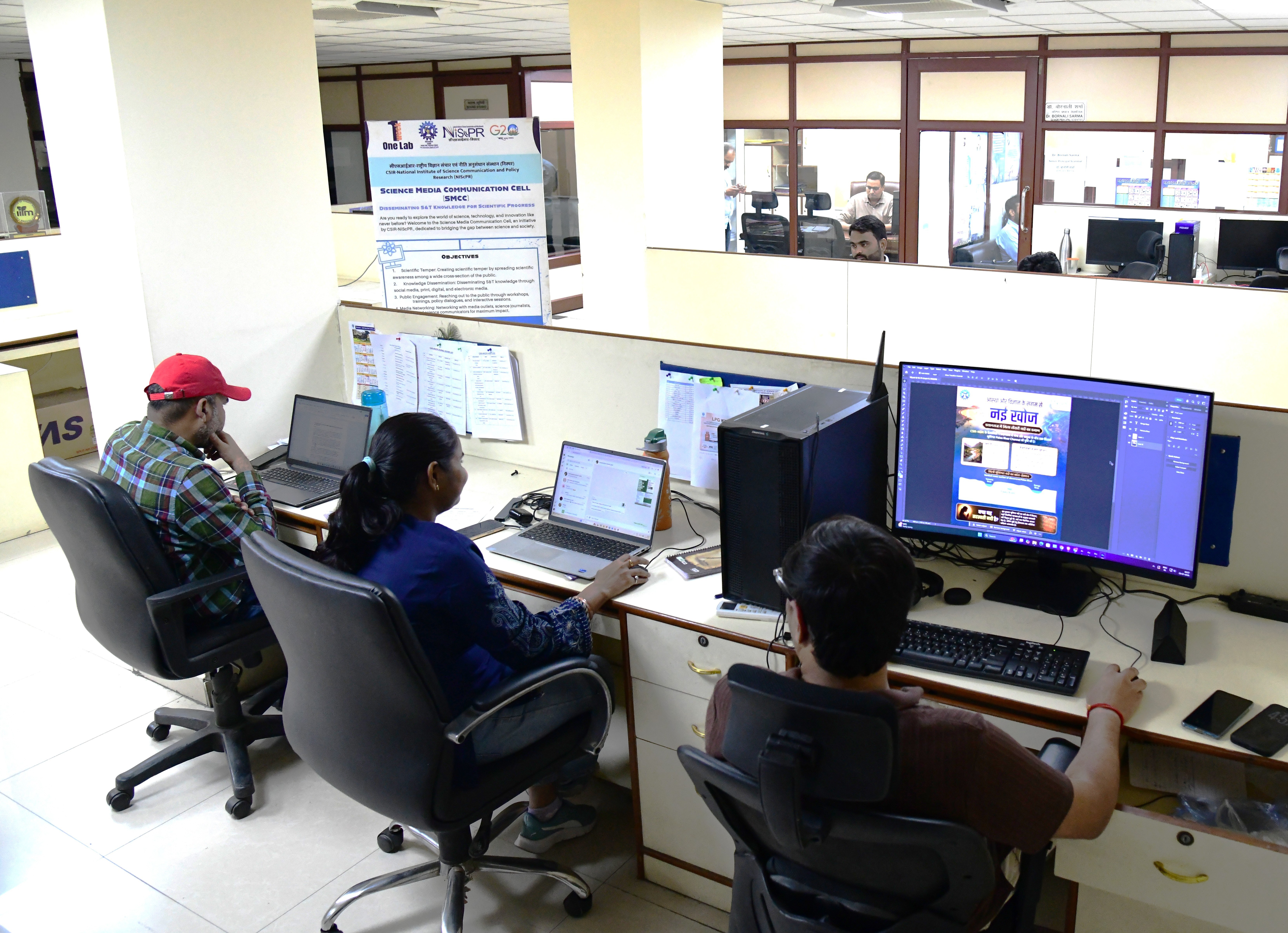
The Science Media Communication Cell (SMCC) is a unique initiative of CSIR–National Institute of Science Communication and Policy Research (CSIR–NIScPR) to strengthen science communication by disseminating research and development (R&D) breakthroughs and achievements of Indian scientific institutions and laboratories through audio-visual, digital, social media, print, and public engagement platforms. It aims to leverage the evolving science communication landscape to effectively connect Indian scientific advancements with society and promote greater public awareness and engagement with science.
GENESIS OF SMCC
India's scientific institutions have played a significant role in the nation's scientific and technological progress since Independence by generating new knowledge, innovations, and technologies that benefit society. To effectively communicate these achievements, NIScPR established the Science Media Communication Cell (SMCC) to bridge the gap between science and society. SMCC responds to the evolving media landscape, including digital and social media, by disseminating scientific knowledge, promoting public engagement, and fostering scientific temper in line with Article 51A(h) of the Indian Constitution. It also supports the communication of scientific achievements from India's ministries, departments, and research institutions, complementing national initiatives such as the Anusandhan National Research Foundation (ANRF).
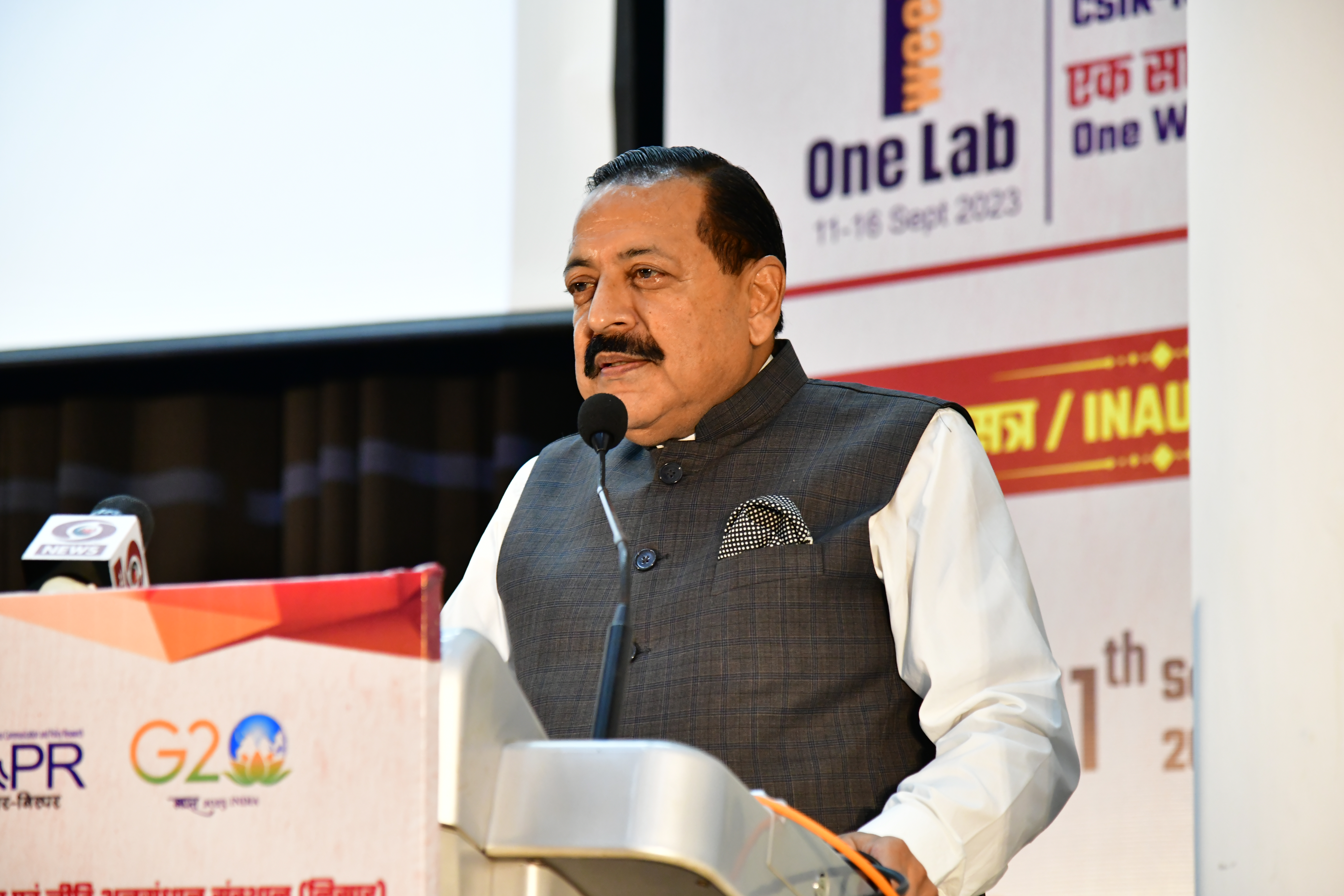
The Science Media Communication Cell (SMCC) was inaugurated on 11 September 2023 by the Union Minister of State (Independent Charge) for Science & Technology and Vice President, CSIR, Dr. Jitendra Singh during the inaugural session of the One Week One Lab programme at NIScPR. The Institute has recruited media and journalism professionals and is developing dedicated infrastructure, to strengthen science communication and public outreach across the country.
KEY OBJECTIVES
SMCC not only envisages the dissemination of scientific information but also aims to give benefit of this information to scientific fraternity and common people. In view of this, the following objectives have been envisaged for the SMCC.
Inculcation of Scientific Temper: Creating scientific temper by spreading scientific awareness among the public.
Knowledge Dissemination: Disseminating S&T knowledge through social media, print and electronic media.
Public Engagement: Reaching out to the public through workshops, trainings, policy dialogues, and interactive sessions.
Media Networking: Networking with media outlets, science journalists, and science communicators for maximum impact.
Outreach activities: It includes branding, workshops, trainings, lectures, and brainstorming meetings for strengthening the objectives of the initiative.
Overcoming Language Barriers: Currently content is being prepared in two major languages (English and Hindi) but SMCC envisage continuing activities in many more Indian languages like Urdu, Bangla, Marathi, Tamil, Gujarati, and Malayalam, etc.
KEY ACTIVITIES
The Science Media Communication Cell (SMCC) aims to communicate the research and development (R&D) breakthroughs and achievements of Indian scientific institutions to the public in simple, engaging, and media-friendly formats. Its key objectives include:
- Preparing science and technology (S&T) content such as news reports, feature articles, blogs, interviews, profiles, and analytical pieces.
- Developing multimedia content, including infographics, illustrations, and other visual communication materials.
- Producing audio-visual content such as short films, documentaries, videos, and podcasts.
- Promoting India's scientific achievements and R&D milestones through digital and social media platforms, including X, Facebook, Instagram, and YouTube.
TARGET GROUPS & OUTREACH
SMCC serves a diverse audience comprising both the scientific and non-scientific communities. Its primary target audience is the general public, with a focus on making scientific knowledge accessible in simple and engaging formats. The initiative also reaches students, researchers, teachers, media professionals, policymakers, and industry stakeholders to promote scientific awareness, evidence-based thinking, and interest in STEM.
SMCC further benefits farmers, artisans, entrepreneurs, start-ups, and other community groups by disseminating research outcomes and technological innovations that can improve livelihoods and support the vision of Viksit Bharat. Through its outreach activities, SMCC aims to strengthen public understanding of science, combat misinformation, and encourage the adoption of scientific innovations for societal development.
SMCC NODAL NETWORK
Each scientific Ministry, Department, and laboratory nominates a Nodal Officer to coordinate with SMCC and regularly share information on the latest research, achievements, events, and developments. In addition to the scientific Ministries and Departments of the Government of India, SMCC has established coordination with laboratories under the Department of Biotechnology (DBT), Department of Science and Technology (DST), Ministry of Earth Sciences (MoES), and Council of Scientific and Industrial Research (CSIR), and is expanding its network by identifying dedicated nodal officers at the laboratory level to ensure timely and effective dissemination of scientific information.
MAJOR OUTCOMES
-
Media publicity of Science & Technology Events:
SMCC has coordinated media publicity of more than 55 National Programs such as National Science Day and National Technology Day (DST), Chandrayaan-3 Landing (ISRO), One Week One Lab, One Week One Theme, Decadal Achievements and Exhibition (CSIR), Global BioIndia (DBT), INSPIRE-Manak Exhibition 2023 & 2024, ESTIC-2025, IISF-2023, IISF-2024, IISF-2025, Bharatiya Vigyan Sammelan (BVS)-2025, DSIR Foundation Day.
SMCC leveraged electronic media like Doordarshan, All India Radio, and Community Radio to disseminate scientific achievements, reaching a broader audience. SMCC has coordinated more than 27 TV stories telecast on Doordarshan till now.
-
Video Campaign:
SMCC conducted a micro-video campaign focused on each CSIR lab in September 2025 to celebrate CSIR Foundation Day, showcasing research, technologies, success stories, and achievements of all labs. It resonated with stakeholders and the general public, and they got more informed.
-
Employment News Column:
SMCC developed 27 success stories on the achievements of Indian laboratories, mainly CSIR labs, which were published as a regular column in Employment News. The initiative enhanced the visibility of Indian R&D, generated increased requests from laboratories for coverage, and facilitated industry outreach, with several companies approaching CSIR laboratories for technology adoption. It also promoted scientific awareness, particularly among students and young professionals, while strengthening the visibility of CSIR–NIScPR.
-
Popular Articles:
SMCC collaborates with leading science magazines, newspapers, and news bulletins, including Blitz India, Science Reporter, Vigyan Pragati, Science Ki Duniya, Aavishkar, Invention Intelligence, Electroniki Aapke Liye, and Vigyan Sampreshan, as well as several regional publications. Through these partnerships, over 80 science articles have been published, significantly expanding the reach and visibility of Indian scientific research and innovations.
-
Language Bulletins of IISF 2023:
During India International Science Festival (IISF) 2023, SMCC introduced a new initiative by publishing IISF News Bulletins in eight Indian languages, in addition to the existing English and Hindi editions. This multilingual approach significantly expanded the outreach of the festival, making its scientific messages accessible to a wider and more diverse audience across the country.
IISF 2023 Special Language Bulletins
-
3-D Selfie points:
To showcase the success stories of Indian labs, primarily SMCC has taken up the task of creating and designing innovative 3-D Selfie points based on milestone achievements of CSIR labs and other S&T Departments. SMCC has designed around 25 such selfie points for CSIR labs, Department of Science and Technology (DST) and Department of Biotechnology (DBT). These Selfie points carry the salient information on scientific achievements as well as R&D success stories of particular Department or laboratory.
-
Exclusive interviews:
On several significant occasions, NIScPR has done exclusive interviews of Hon'ble Minister of State for S&T, DG CSIR, Secretaries of DST, DBT, MoES, ISRO and Directors of various National Laboratories of S&T Ministries/departments and institutions.
-
Social Media Campaign:
Carried out a successful social media campaign for One Week One Theme (OWOT) using the #OneWeekOneTheme hashtag and coordinated with all 37 CSIR labs to disseminate all theme-based events.
-
Collaborations:
SMCC collaborates with leading television and radio networks to disseminate science communication content to a wider audience. Its key media partners include Doordarshan (DD National and DD Urdu), Sansad TV, and All India Radio. Through these platforms, SMCC produces and broadcasts science-based audio-visual content, including short films, documentaries, video capsules, reels, expert talks, interviews, and success stories highlighting India's scientific achievements and innovations.
-
Increase of X Followers:
SMCC has significantly strengthened CSIR–NIScPR's digital outreach, contributing to the organic growth of the Institute's X (formerly Twitter) followers from 12.7K in February 2023 to 17.9K in July 2026—an increase of approximately 5,200 followers over three years.
-
Increase in Public Engagement at Social Media:
Organic reach from 6.5 lakhs to 50 lakhs in three years.
SMCC: CREATING SOCIAL IMPACT
- Science & Society: By simplifying and disseminating complex R&D breakthroughs through films, reels, podcasts, articles, and regional-language media, both initiatives make science accessible to common citizens.
- Democratizing Knowledge: Multilingual dissemination ensures that people from diverse regions and literacy levels can engage with Indian S&T progress, reducing inequality in access to information (SDG 10).
- Empowering Communities: Students, entrepreneurs, science communicators, journalists and healthcare workers benefit directly from science stories, success case studies, and real-time updates on innovations.
- Boosting Public Trust in Science: Coverage of ISRO, ICAR, ICMR, DRDO, and other institutions instil confidence in India’s research ecosystem and motivates youth towards STEM careers.
- Strengthening Policy Alignment: The initiatives support national priorities like STIP 2020 and NEP 2020 by creating awareness on how science contributes to education, health, environment, and livelihood.
- Encouraging Participation: Selfie points, workshops, campaigns like #OneWeekOneTheme, and media engagement foster public interaction with science, turning spectators into participants.
- Wider Reach through Media: Use of TV, radio, community radio, and digital platforms ensure that rural, semi-urban, and urban populations alike benefit from scientific knowledge.
- Inspiring Next Generation: Success stories of Indian laboratories published in Employment News and Popular Science Magazines inspire students and young professionals to pursue careers in science, technology, and innovation by showcasing the societal impact and opportunities offered by scientific research.
MAJOR SCIENTIFIC EVENTS COVERED BY SMCC
- One Week One Lab (OWOL) and One Week One Theme (OWOT)
-
CSIR’s 82nd Foundation Day Celebration and Decadal Achievement Exhibition
- Chandrayaan Mission (2023)
-
INSPIRE-Manak Exhibition 2024 & 2025
India International Science Festival (IISF)
-
National Science Day
-
Global Bio India 2024
-
International Conference on Communication and Dissemination of Traditional Knowledge (CDTK) 2024 & 2025
-
Emerging Science, Technology, and Innovation Conclave (ESTIC) 2025/p>
-
CSIR-ISRO Space Meet - 2025
-
Bhartiya Vigyan Sammelan (BVS) 2025
-
Research Industry Start-up and Entrepreneurship (RISE) Conclave
CSIR-NIScPR SOCIAL MEDIA: CURRENT DATA
An infographic to be inserted here
SMCC IN PRINT MEDIA
Please place Employment News article links here taking from old website
OUR TEAM
Dr. Manish Mohan Gore
Scientist-D
Email: mmg.niscpr@csir.res.in
Ms. Meetali Bharti
Scientist-D
Email: meetali.niscpr@csir.res.in
Ms. Shubhada Kapil
Technical Officer
Email: shubhada.niscpr@csir.res.in
Shri Abhinav Raj
Senior Technical Officer
Email: abhinavraj.niscpr@csir.res.in
Shri Aniruddha Tiwari
Sr. Hindi Translator
Email: a.tiwari@csir.res.in
प्रिंट मीडिया में एसएमसीसी
निस्पर के विज्ञान मीडिया संचार प्रकोष्ठ (एसएमसीसी) को प्रिंट, इलेक्ट्रॉनिक और सोशल मीडिया प्लेटफॉर्म के माध्यम से सभी भारतीय प्रयोगशालाओं से आरएंडडी सफलता की कहानियों को प्रभावी ढंग से प्रसारित करने की महत्वपूर्ण भूमिका सौंपी गई है।
एक रणनीतिक कदम में, एसएमसीसी ने “रोजगार समाचार” के साथ भागीदारी की है, जो नौकरी चाहने वालों के उद्देश्य से एक साप्ताहिक पत्रिका है और भारत सरकार के सूचना और प्रसारण मंत्रालय के प्रकाशन विभाग द्वारा प्रकाशित की जाती है। इस सहयोग ने अप्रैल 2024 से रोजगार समाचार में डीआरडीओ, सीएसआईआर प्रयोगशालाओं, आईसीएमआर और अन्य सहित विभिन्न भारतीय प्रयोगशालाओं से आरएंडडी सफलताओं, उपलब्धियों, सफलता की कहानियों और प्रौद्योगिकियों को उजागर करने वाले लेखों के विकास और प्रकाशन की सुविधा प्रदान की है। हमने मिशन शक्ति, अमिट स्याही, मेडटेक को कवर किया है। मित्रा और रमन स्पेक्ट्रोमीटर आदि तथा इसरो और डीएई सहित और भी कई कहानियाँ पाइपलाइन में हैं।
यह पहल सुनिश्चित करती है कि भारतीय अनुसंधान में की गई अभिनव प्रगति को व्यापक दर्शकों तक पहुँचाया जाए, जिससे एक सुविज्ञ जनता को बढ़ावा मिले और वैज्ञानिकों और शोधकर्ताओं की अगली पीढ़ी को प्रेरणा मिले।
| 2025 | |||||
|---|---|---|---|---|---|
| 11-17 जनवरी 2025 | |||||