Doley, D. M., & Barman, P. (2025). The role of biodiversity communication in mobilizing public participation in conservation: A case study on the greater adjutant stork conservation campaign in Assam, Northeast India. Journal for Nature Conservation, 84, 126847. https://doi.org/10.1016/j.jnc.2025.126847
Studies in Science Communication Division
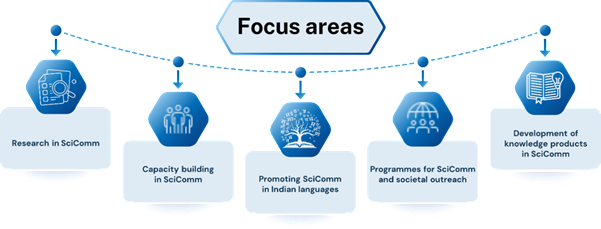
The Studies in Science Communication Division, CSIR-NIScPR aims to strengthen inclusive Science Communication (SciComm) and SciComm research. The major focus areas of the division are:
- Research in science communication
- Capacity building in science communication
- Promoting science communication in Indian languages
- Development of knowledge products in science communication
- Organising programmes for science communication and societal outreach
Recent Projects
- Science Communication in Assamese: Promoting Endeavours to Break the Language Barrier (NIScPR/OLP/0038)
- Assessing Digital Health Literacy and Health-Related Misinformation on Social Media and Drafting Recommendations on the Use of Online Platforms for Health-Related Information (NIScPR/OLP/0040)
- Evaluating Science Communication Efforts in Indian Languages and Drawing Policy Recommendations to Strengthen Science Contributions in Indian Languages (NIScPR/OLP/0042)
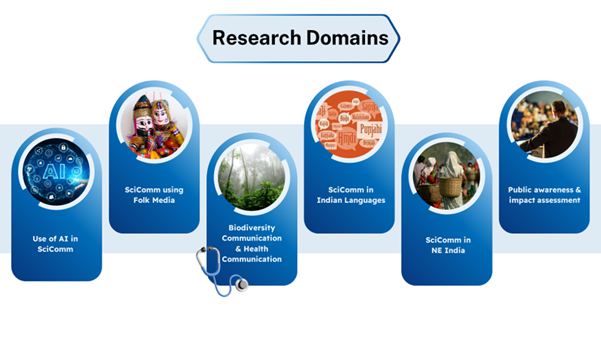
- Breaking the Barriers in Science Communication using Folk Media and Indian Languages: A Study with a Focus on North East India (NIScPR/OLP/0066)
- Evaluating Science Communication Efforts in Indian Languages and Drawing Policy Recommendations through Stakeholder Engagement and Content Creation
- Sodium Ion Batteries: A Study on the Research Progress and Policy Pathways for Sustainable Energy Solutions
- Science Communication in the Age of Artificial Intelligence: Status and Challenges in Indian languages
- Developing Robust Frameworks for Science Communication in Northeast India: Dissemination Strategies, Capacity Building, Impact Assessment, and Policy Perspectives.
Major Recent Activities
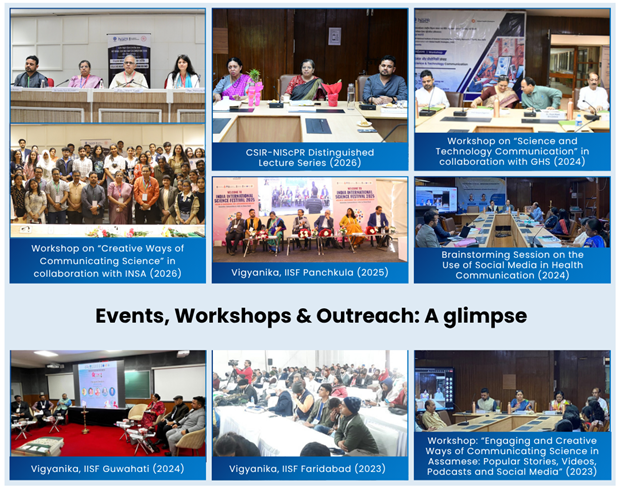
- CSIR-NIScPR Distinguished Lecture Series
- CSIR-NIScPR Faculty & Student Lecture Series
-
Vigyanika Science Literature Festival, India International Science Festival
- Vigyanika 2023 (Faridabad, Haryana)
- Vigyanika 2024 (IIT Guwahati, Assam)
- Vigyanika 2025 (Panchkula, Haryana)
- Conducted multiple science communication workshops and outreach programmes across India.
Recent Publications
References
Paliwal, B. K., Phogat, P., Mudassir, M., Kumar, J., & Wan, M. (2025). Impact of age and educational qualifications on food label awareness: A study of edible oils and fats in India. Nutrition, 134, 112727.
Laxmi, Vijay, Gore, Manish Mohan and Goel, Alok Kumar (2025). Behavioural Views on HIV/AIDS: A Primary Feedback Survey in the Delhi NCR Region. Communicator. Vol. LX (2), 40–45.
Misra, T., Barber, J., Manu, G., Malani, V., Kamak, M., Phalkey, J., & Barman, P. (2025). Weaving Science into Creative Writing: Integrating interdisciplinarity into young adult learning. Southern African Journal of Environmental Education, 42(1), 1–27.
Rab, S., Wan, M., Yadav, S., & Achanta, V. G. (2025). National Physical Laboratory, India: Tryst with Metrology and the Metre Convention: S. Rab et al. MAPAN, 40(3), 605–617. https://doi.org/10.1007/s12647-025-00856-4
Sukuru, P., Mazumdar, M., & Barman, P. (2025). Measuring the Impact of a Science & Technology Communication Workshop on Participants’ Attitudes. Journal of Scientific Temper (JST), 13(1), 36–52. https://doi.org/10.56042/jst.v13i1.15789
Rab, S., & Wan, M. (2025). The Big G Precision Puzzle. Current Science (00113891), 129(1).
Phogat, P., Rab, S., & Wan, M. (2025). Science communication in the digital age: Trends, gaps, and interdisciplinary opportunities. Information Services and Use, 45(1–2), 148–163. https://doi.org/10.1177/18758789251342896
Rab, S., Wan, M., & Yadav, S. (2024). From quecto to quetta: The Fascinating Evolution of SI Unit Prefixes. Resonance, 29(5), 639–644. https://doi.org/10.1007/s12045-024-0639-7
Paliwal, B. K., & Wan, M. (2024). Evolution of food labeling research and current publication trends: A scientometric analysis. Journal of Scientometric Research, 13(2), 535–546. https://doi.org/10.5530/jscires.13.2.42
Rab, S., & Wan, M. (2024). Syncing Moon and minutes: the call for lunar time standards. Current Science (00113891), 126(8).
Doley, D. M., & Barman, P. (2023). Importance of communicating biodiversity for sustainable wildlife management: a review. Journal of Environmental Studies and Sciences, 13(2), 321–329. https://doi.org/10.1007/s13412-023-00819-8
Barman, P., Lakshmi, S. P., & Anwar, M. K. (2023). Public Perception of Folk Media and its Importance in the Dissemination of Science. Journal of Scientific Temper (JST), 11(2), 67–77. https://doi.org/10.56042/jst.v11i2.1081
Doley, D.M., Barman, P. (2026). Empowering Indigenous Women in Conservation Efforts Through Participatory Roles and Livelihood Generations in India’s Northeastern Region. In: Moran, N., Singh, P., Kumar Singh, K. (eds) The Participatory Role of Indigenous Women. Springer, Cham. https://doi.org/10.1007/978-3-032-24059-0_7 (book chapter)
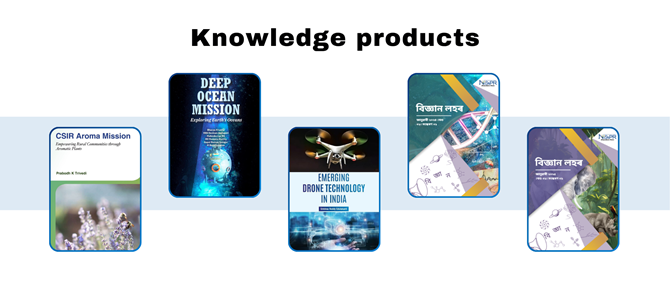
Other Knowledge Products
Team Details
Dr Paramananda Barman (Head)
Dr Manish Mohan Gore
Dr Meher Wan
Mohd Faisal Nawaz
Contact: param.niscpr@csir.res.in
Recent Achievements / Recognitions
- Members of the division contributed towards school science textbook development by NCERT: Meher Wan, Curiosity, grade 6–8; Paramananda Barman, Curiosity, grade 7–8.
- MM Gore received the “Jagpati Chaturvedi Bal Vigyan Lekhan Samman” from Uttar Pradesh Hindi Sansthan, Govt of Uttar Pradesh for contributions in popular science writing for children.
- Member, Indian National Young Academy of Science (INYAS): Paramananda Barman (2026) & Meher Wan (2022).